We embarked on another journey — more of a getaway from a hectic pace of life. The trip wasn’t a leisurely one. We had packed it with a schedule. This one had a purpose.
Some say it was divine.
Our choice of travel was Rishikesh-Joshimath-Badrinath.
It seemed an optimal choice, given the quick drive from Delhi and the chance to escape the sweltering heat. However, it turned out to be the most democratic choice, since all wheels rolled towards this ancient and spiritual retreat.
We started early, around 6 am. We could beat a significant percentage of the population who felt 6 am wasn’t a great time to break their blissful sleep.
Soon we were cruising down the newly constructed Delhi-Dehradun highway. Spic and span and pristine, it was still getting used to the unruliness of Indian traffic. There was an unexplained rush which contrasted the easy-going morning. The sun had cleared the horizon and witnessed each irate driver firsthand as we moved east. The dark goggles created a fighter-pilot vibe, and every competing driver followed suit with their own jet-speed drive.
The dhabas were strewn along the road, professing pure vegetarian and ‘Satwik’ food. We stopped at the one with the largest hoarding. I realised the quality of food was important, but what mattered most was advertisement. There were all types of cuisines, from South Indian dosas to Punjabi parathas. Each found their own way to fill the hearts and bellies.
We did too.
We reached Rishikesh by around noon. As we stepped out of the AC bubble of our car, we realised the Delhi heat had a cousin in Rishikesh too. The town is considered the “Gateway to the Garhwal Himalayas” and the Char Dham. It is associated with penance by sages and meditation on the banks of the Ganga. It has now transformed into a hub of adventure activities including river rafting, bungee jumping, and many other adrenaline-inducing pursuits. The spiritual vibe was mingling uneasily with the high-octane rush. The city derives its name from Hrishikesha — a form of Vishnu meaning “Lord of the Senses.” The streets provided enough to overwhelm all senses — sight, smell, sound, taste, and touch.
We decided to declutter our hectic plans. The adventure activities were struck off.
Maybe that wasn’t the purpose. Nor our vibe.
The evening plan was to attend the Ganga Aarti at the ghats of the holy Ganga. There were two famous venues — Parmarth and Triveni Ghat. The Aarti at Parmarth was located on the eastern bank, the quieter side, organised by Parmarth Niketan Ashram. Triveni Ghat was on the western side of the river and offered a more traditional public ghat experience — more crowded and energetic.
We chose to attend the Aarti at Parmarth Niketan.
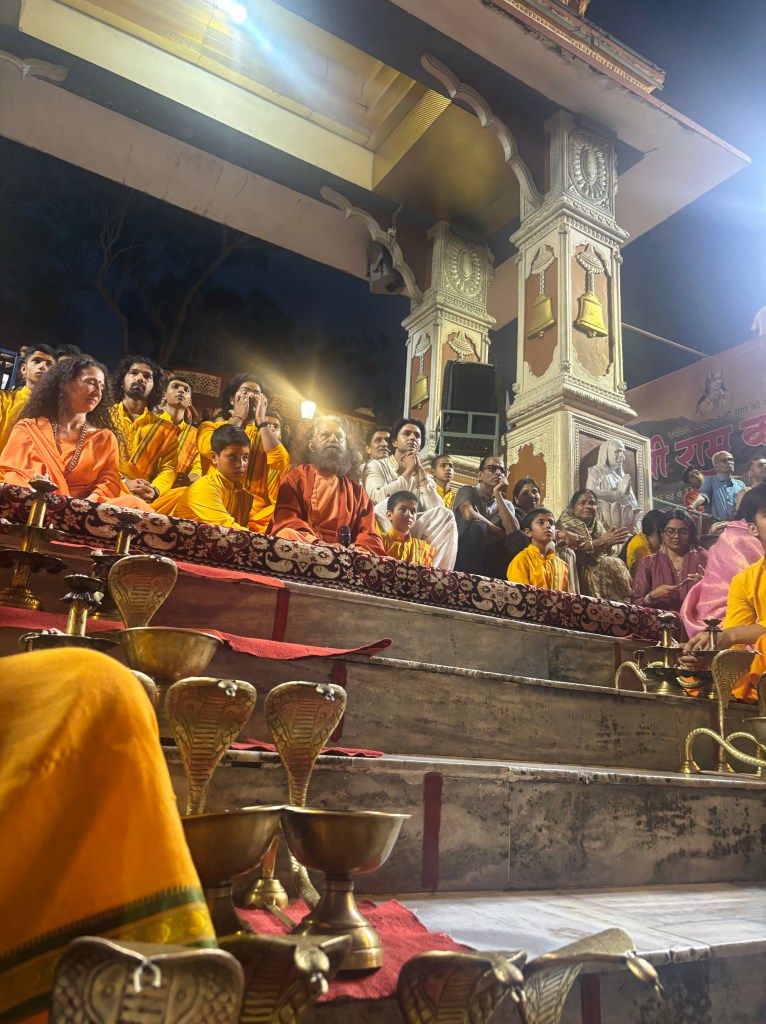
It was a spiritual experience and an Instagram-worthy spectacle. A mix of people crowded the marbled banks of the holy river — those who experienced the tranquility with closed eyes, and others who covered the event live on their social media. It is surely an unmissable event when you visit Rishikesh.
The next day we started at 5 am. The wisest thing to do. It saved us a few hours and gifted us a priceless view of the rising sun — not yet hot.
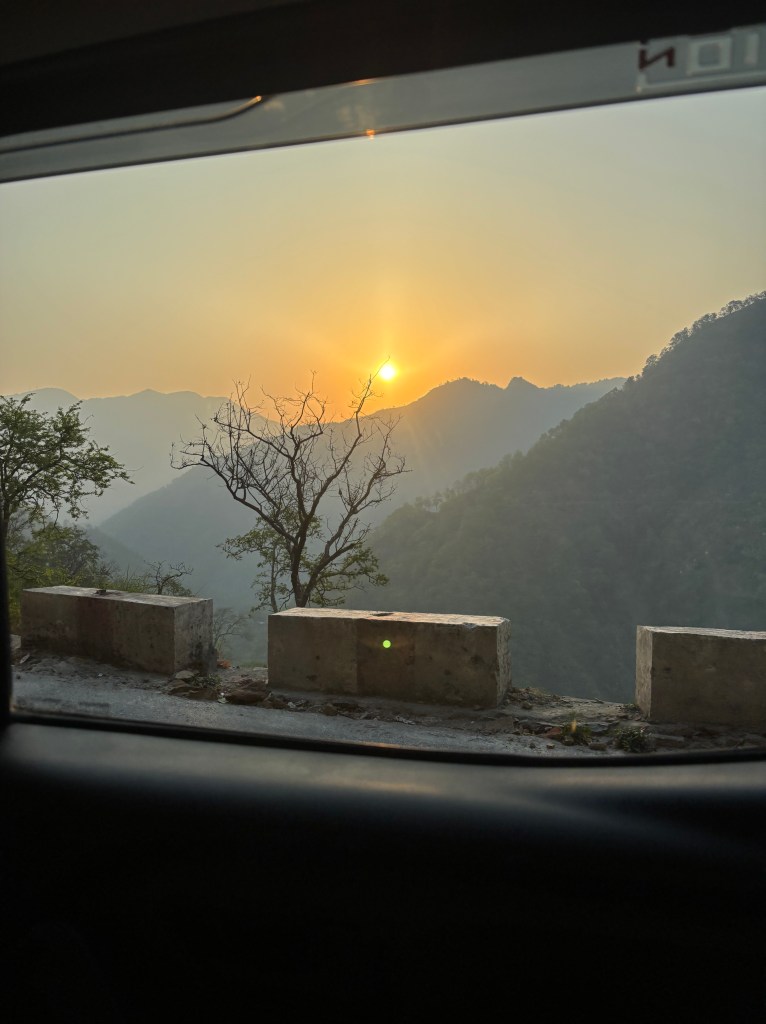
We were travelling along the mythological route from the ‘material’ to the ‘spiritual’ world. The route was filled with halts having mythological, historical, or yogic associations. It had five major river confluences, each carrying spiritual significance and references to incidents related to the epic Mahabharata.
We were fascinated by both.
We reached Devprayag, one of the five holy confluences. Here, the Alaknanda and Bhagirathi merge to become the river Ganga. Science explains how water runoffs from various watersheds meet to form tributaries and eventually a river. It also explains the mixing of waters with differing compositions. But spiritually, it is a merger of two separate identities to create something bigger — a sense of dissolution of pride. I could watch the two rivers happily gushing forth to their ends. In some ways, I realised they saw this dissolution not as an end, but as a new beginning.
Maybe there was a lesson for us.
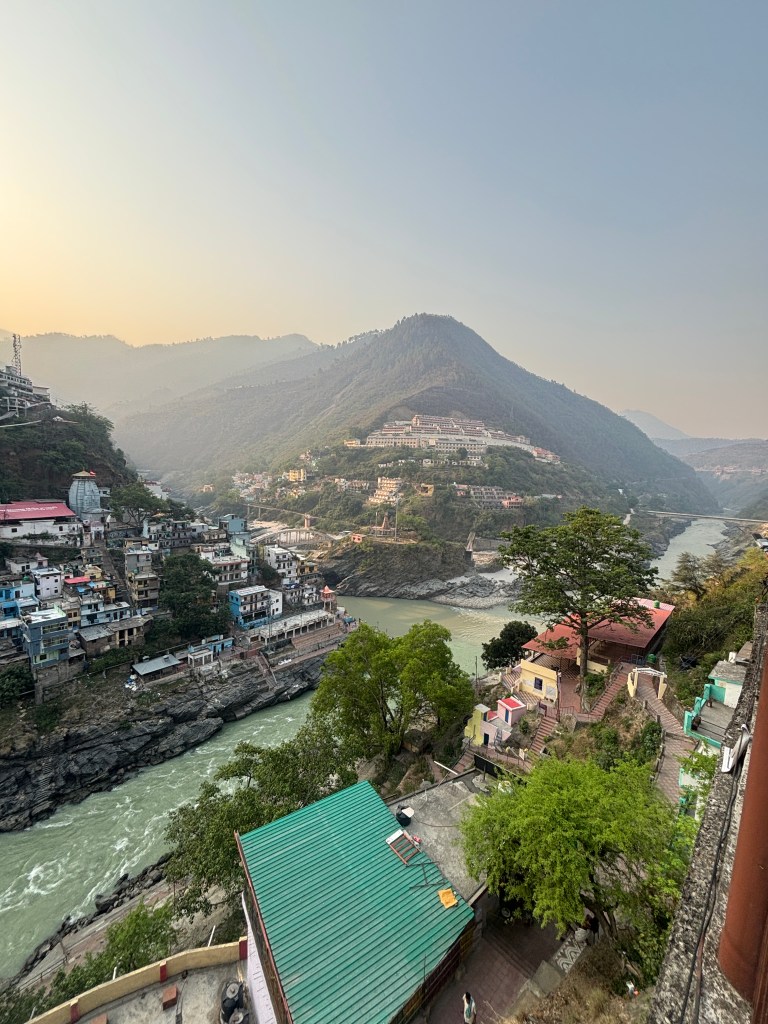
Confluences were not only spiritual — they were also culinary. The confluence sites were thickly populated with food joints, capitalising on pilgrims who halted to take a holy dip. We relished pakodas and chai while we waited for the traffic to resume. Bhagirath waited thousands of years to bring the celestial river Ganga to Earth and liberate the souls of his ancestors. We waited only a few hours for the traffic to clear.
We couldn’t complain. We climbed further up towards the greater origins.
Along the route, we encountered convoys of Sikh pilgrims heading to Hemkund Sahib and Hindu pilgrims heading to Badrinath. It was a confluence of another kind. One wishes we could lose our identities to form one bigger identity through such dissolutions. But we aren’t rivers, I suppose.
Battling the traffic, we learned the art of patience — waiting calmly, staying on our side of the road — and forgiveness, when insolent drivers pushed ahead and worsened the jam. Eventually, as night fell, we reached the holy city of Badrinath.
Abode of Badri Vishal, Badrinath is a revered Vishnu shrine and part of the Char Dham Yatra — the spiritual pilgrimage to four holy sites, the other three being Kedarnath, Yamunotri, and Gangotri. It is believed to be the place where Vishnu sat in deep meditation, sheltered by Goddess Lakshmi, who took the form of the Badri tree. The presiding idol depicts Lord Vishnu in a meditative form of deep contemplation.
The shrine felt small in relation to the enormous number of pilgrims who come seeking blessings and absolution. Humans swarmed in search of God, queuing to enter the shrine, presuming they would find him there. I tried to imagine God confined within those walls.
There was a line stretching nearly 4 to 5 kilometres. The wait ranged from 9 to 10 hours, sometimes an entire day. There were two kinds of pilgrims — those who waited in line, and the privileged ones who could afford priority passes for an express darshan. Each paid a suitable price. The waiting ones paid with discomfort and time, while the privileged paid with money and, in certain cases, a quiet prick of guilt.
We were the privileged ones, pricked by guilt.
We witnessed the last nightly ritual — something very peculiar. In the presence of devoted worshippers who filled the inner sanctum, the Lord is stripped of his grandeur, his adornments and ornaments. All that remains is a simple ascetic form. It was a profound spiritual experience. I realised that the Lord was what resided within, beneath all those glittering ornaments. His grandeur, had no need for external adornments.
Perhaps we don’t either.
But we are humans. Not yet God.
Badrinath and its surrounding villages are studded with mythological and spiritual stories. After the morning darshan the next day — less crowded and more peaceful — we decided to explore history and myth.
Our first halt was the site where the fierce and mystic river Saraswati astonishingly disappears. The river Saraswati — divine goddess of wisdom, speech, and knowledge — descends with fierce energy from the rocky Himalayan mountains, then plunges into a deep pit, only to emerge as a trickle that merges with the Alaknanda at Keshav Prayag. The belief is that the greater portion of the river flows into the netherworld. Perhaps, by remaining hidden, it stays unsullied — saved from industrial pollution and human folly. Maybe that is wisdom.
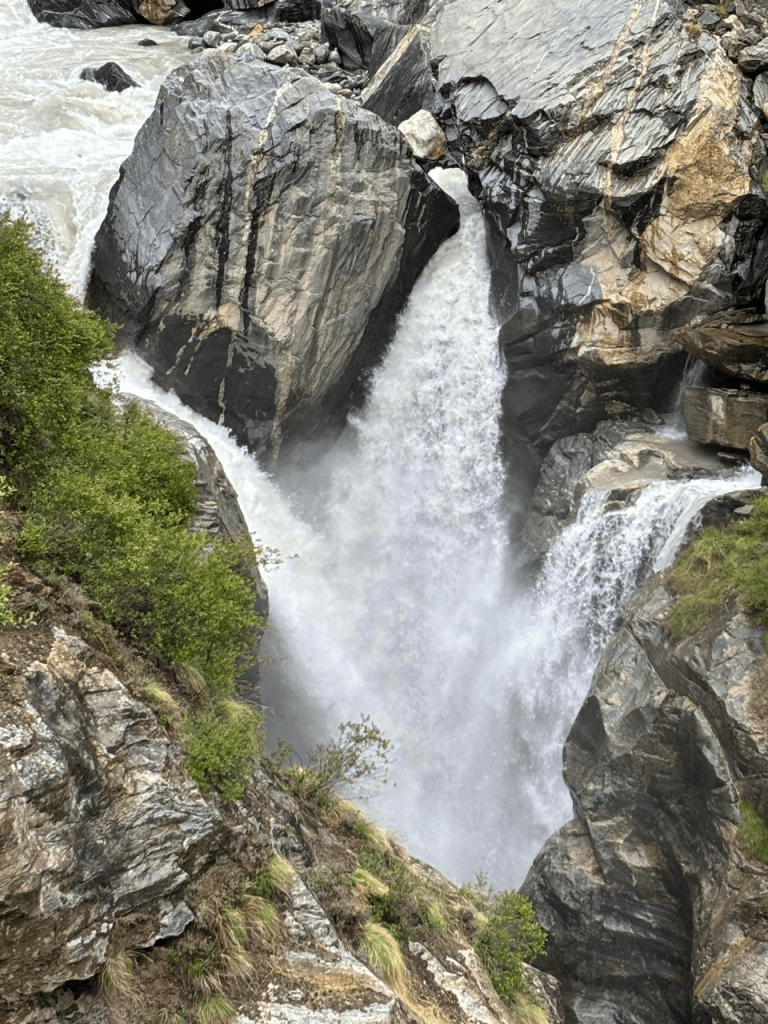
Across the raging river Saraswati, just before it disappears, lies a massive rock bridge — Bheem Pul.
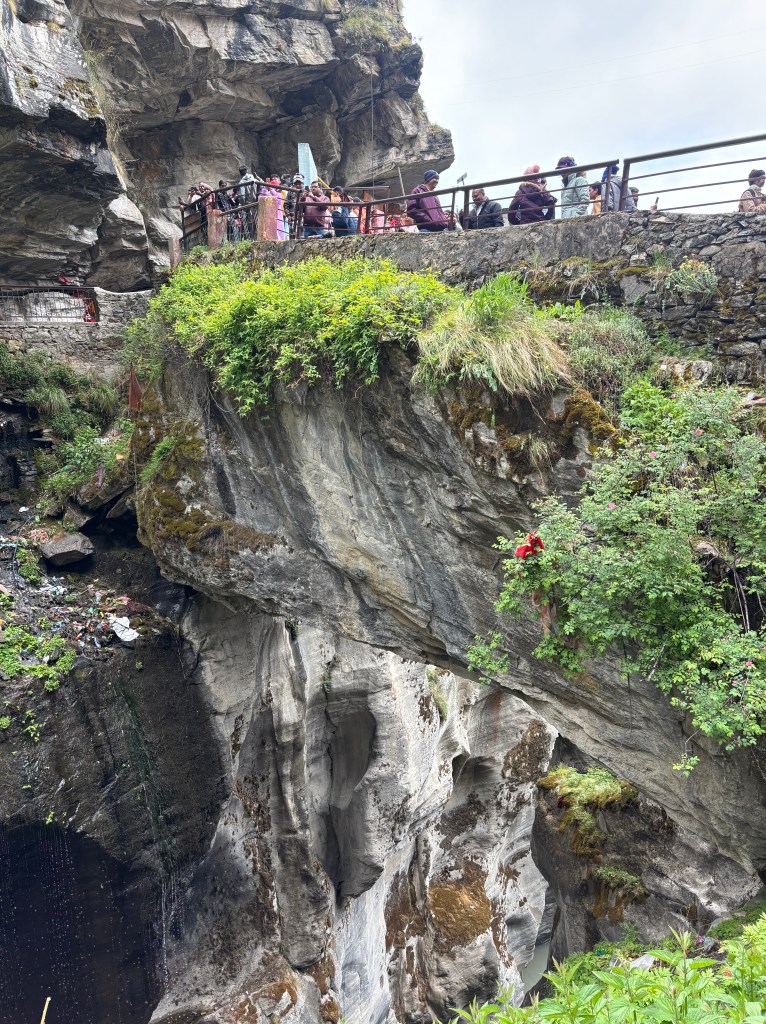
An apparently insignificant rock bearing the giant fingerprints of a hero of the Mahabharata. The size of the rock hints at the stature and strength of the second son of Kunti. I am not certain whether it is truth or myth. But standing at Bheem Pul, I could vividly picture Mighty Bheem lifting the rock and slamming it across the river to help Draupadi cross to the other side. It must have been an easy, almost insignificant task for him. And yet, they were crossing the mystic river Saraswati — embarking on a journey to a destination no less than heaven itself.
Unlike the Pandavas, we had to return to the world.
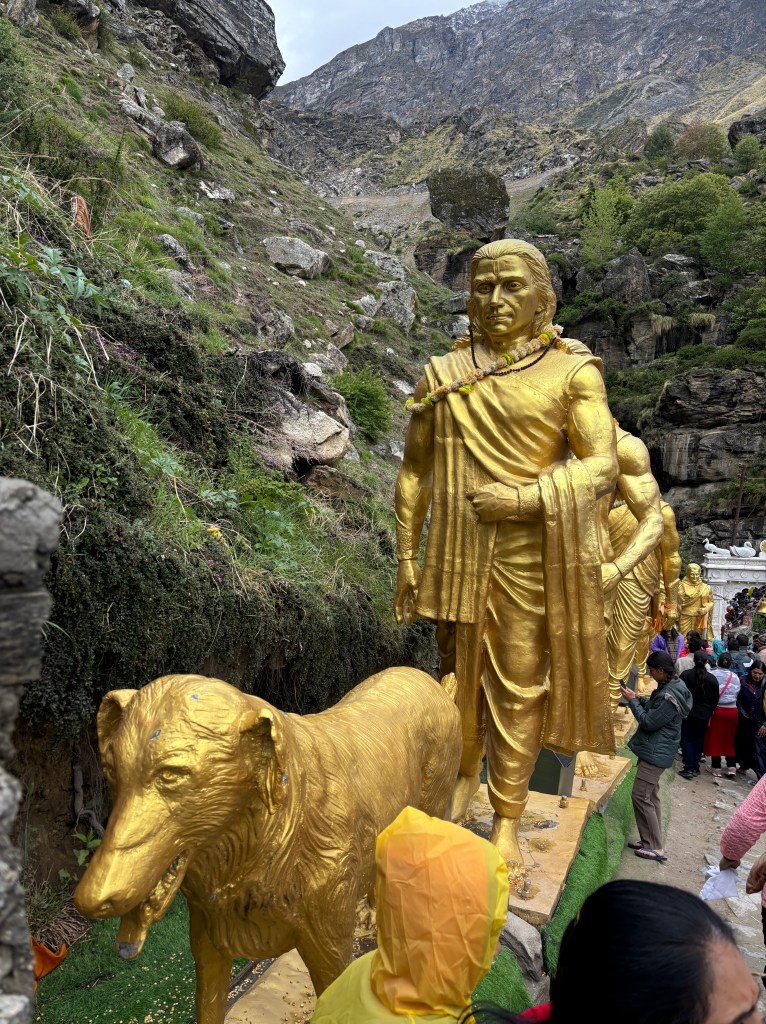
Walking back, we visited the cave where Lord Ganesha is said to have written the entire Mahabharata. According to the story, Lord Ganesha was requested by Sage Vyasa to transcribe the epic without error. Lord Ganesha agreed on one condition — that Vyasa must recite without pause. To counter this, the clever sage asked Lord Ganesha to fully understand each verse before writing it, thus buying himself time to compose the next lines. There was no scope for a writer’s block when scribing the greatest epic of humankind.
We moved out of Badrinath and headed back to Joshimath. As we packed our bags and vacated our room, we paused to look at the view from the window. Remembering the little time spent there, we felt a reluctance to leave. It felt like leaving a body behind — an attachment formed quietly at deeper levels.
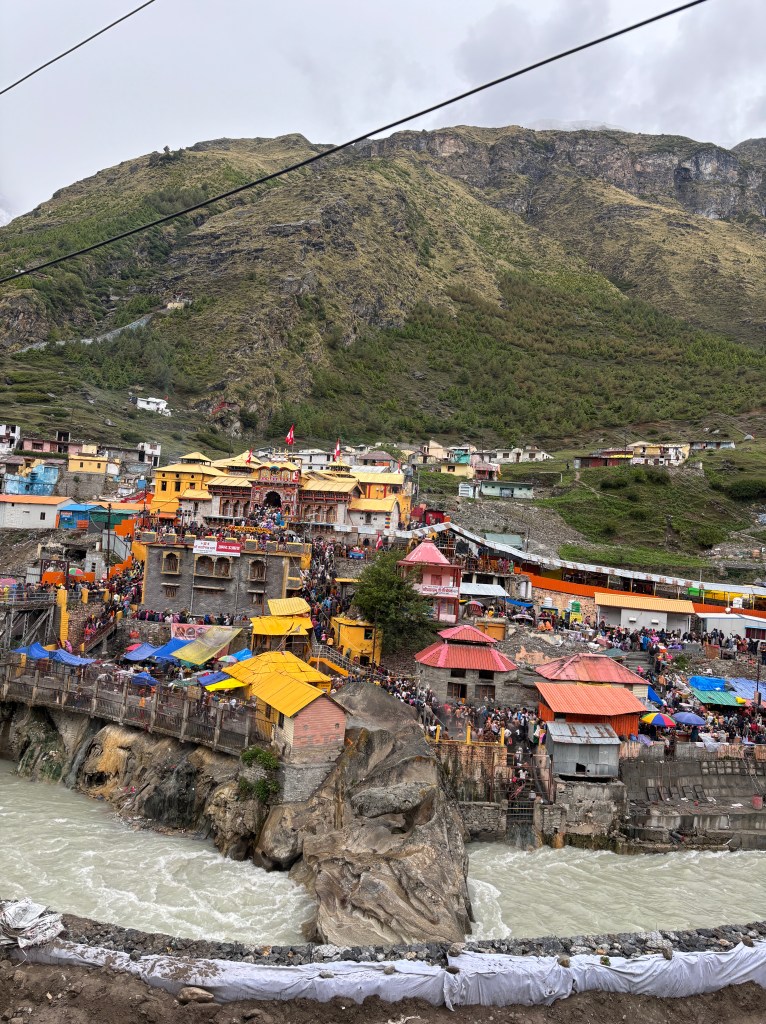
Yet there was no choice.
We spent a night at Joshimath and decided to have dinner at Tatwa Restaurant and Bar. In the midst of our spiritual journey, the place offered a striking contrast. It was aesthetic, with a quiet atmosphere despite the steady rhythm of techno music playing in the background. We sipped bourbon and quietly watched the starry night, half-covered in patchy white clouds.
The clouds gathered, and it began to rain.
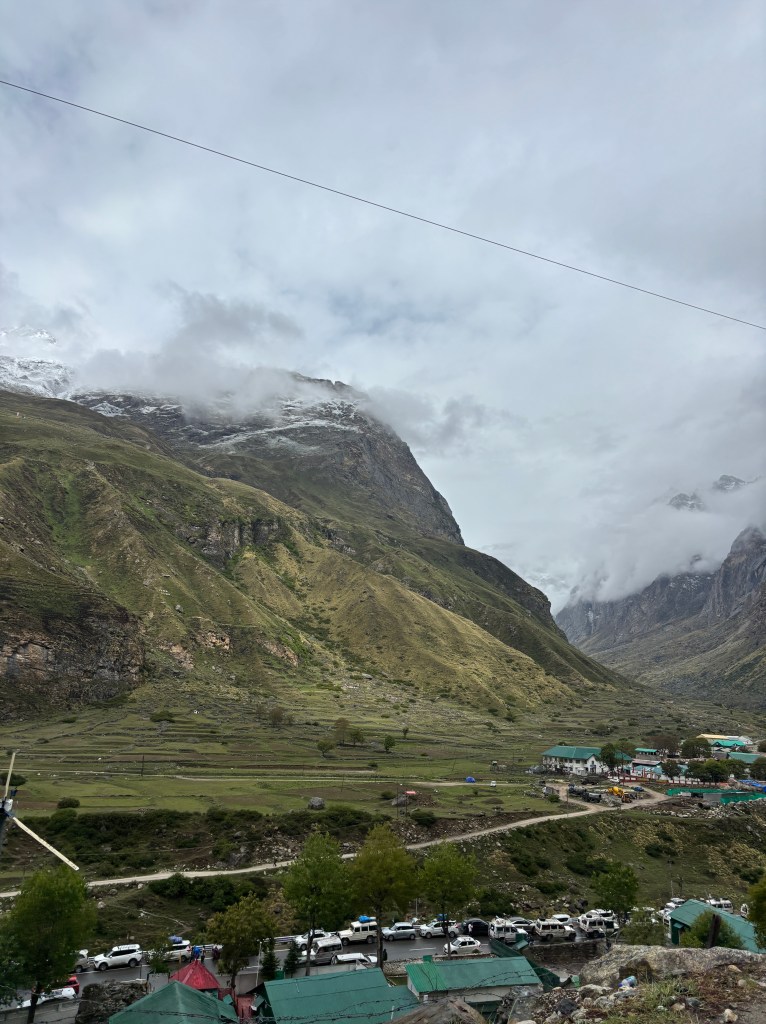
The overnight rains cooled the temperatures and made the journey back down the spiritual path more comfortable. An early start once again gave us the edge — though we found ourselves stuck in traffic near Vishnu Prayag. We passed the time eating pakodas and peanuts.
We were not in a rush.
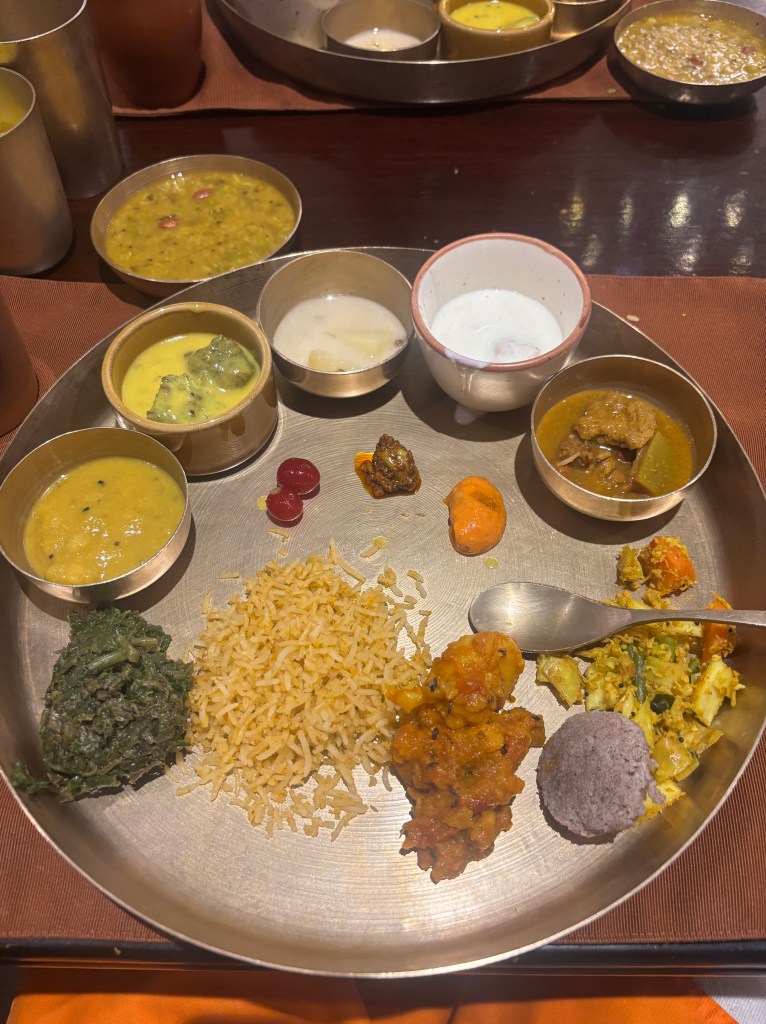
We reached Rishikesh late in the evening, around 6 pm. Eager to explore, we headed out and booked a table at VARR Restaurant. The restaurant features a unique menu — sacred meals or ‘Prasadam’ from various famous temples across the country. It promised a unique experience, and it delivered. The meal was premium-priced, which perhaps explained the sparse crowd, with most tourists preferring the cafés at Tapovan or along the riverfront. Nevertheless, it turned out to be a remarkable dining experience. A must-try.
We then decided to visit Triveni Ghat, which we had missed on the way up. It was around 9 pm when we arrived. The ghat wore the tired look of a place that had seen a long, busy day. The heavy footfall of tourists was visible in the trash left strewn around. We found a cleaner spot and sat by the river. We bought small floating diyas and offered them to the Ganga. The ritual is said to be a grand spectacle — especially just after the Ganga Aarti, when hundreds of devotees release their diyas together, and the reflection of all those lights on the water becomes mesmerising. Our solitary diya quietly drifted downstream as we watched in silent prayer. The dark, tranquil water flowed steadily, as if maintaining a vow of silence.
We sat quietly too.
The next day was our last. We had originally planned to drive back to Delhi at daybreak, but decided instead to stay and explore the city until noon. In the morning, we booked a yoga session — Pranayama and Hatha Yoga. There were many options available, including an elaborate one on the riverfront. We settled on a session in a quiet hall near Tapovan. It was surprisingly both tiring and deeply relaxing. We finished by around 9 am, leaving the entire day ahead with no fixed plan.
A day without a plan feels longer than a day with one.
Time is a mysterious concept.
We look for certainty, as always — and even without a plan, a plan eventually emerges. We drifted towards Laxman Jhula, carried along by the flow of the crowd. The shouts and honks were loud enough to numb the mind. The risk of being swept aside by speeding rafting jeeps was very real. Yet, keeping our faith in some cosmic plan, we kept walking — relying on the traditional method of asking passersby for directions along the narrow lanes leading to Laxman Jhula.
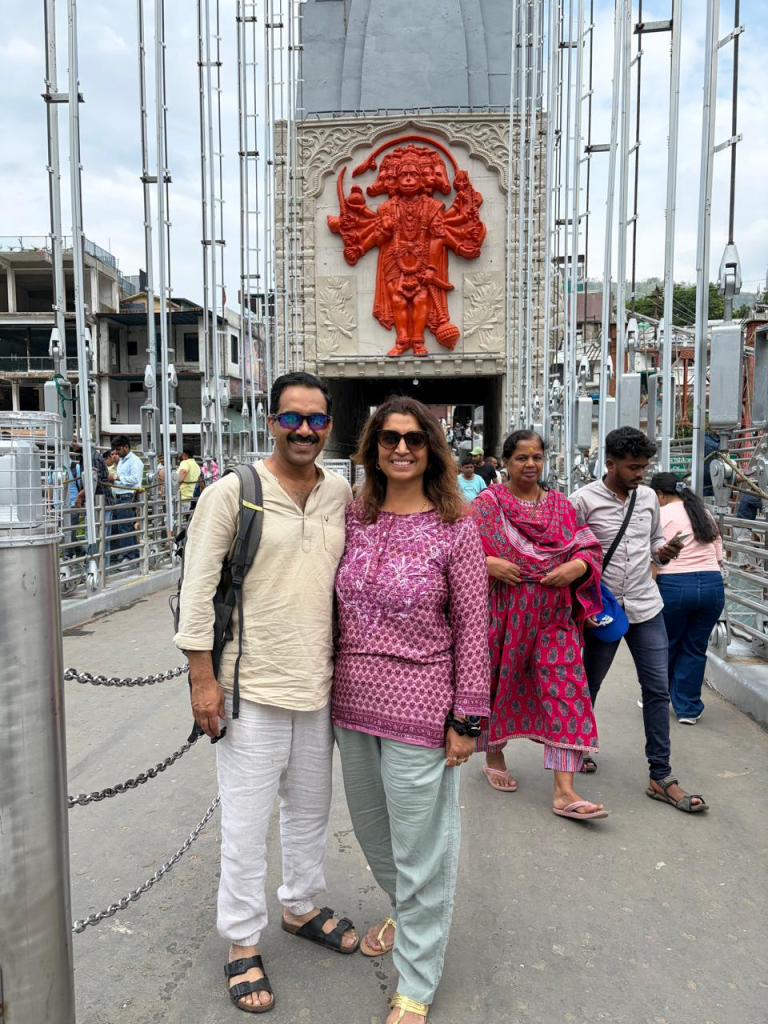
In our seemingly aimless stroll, we did manage to reach the iconic bridge. The suspension bridge had a toughened glass bottom walkway running alongside. It had been closed by the administration, possibly for safety reasons. Yet the crowd was undaunted — climbing over railings to enter the restricted area, unabashedly taking pictures and making reels, creating digital evidence of their own violation. They didn’t care. And neither, it seemed, did the administration.
A rule is only as strong as its enforcer.
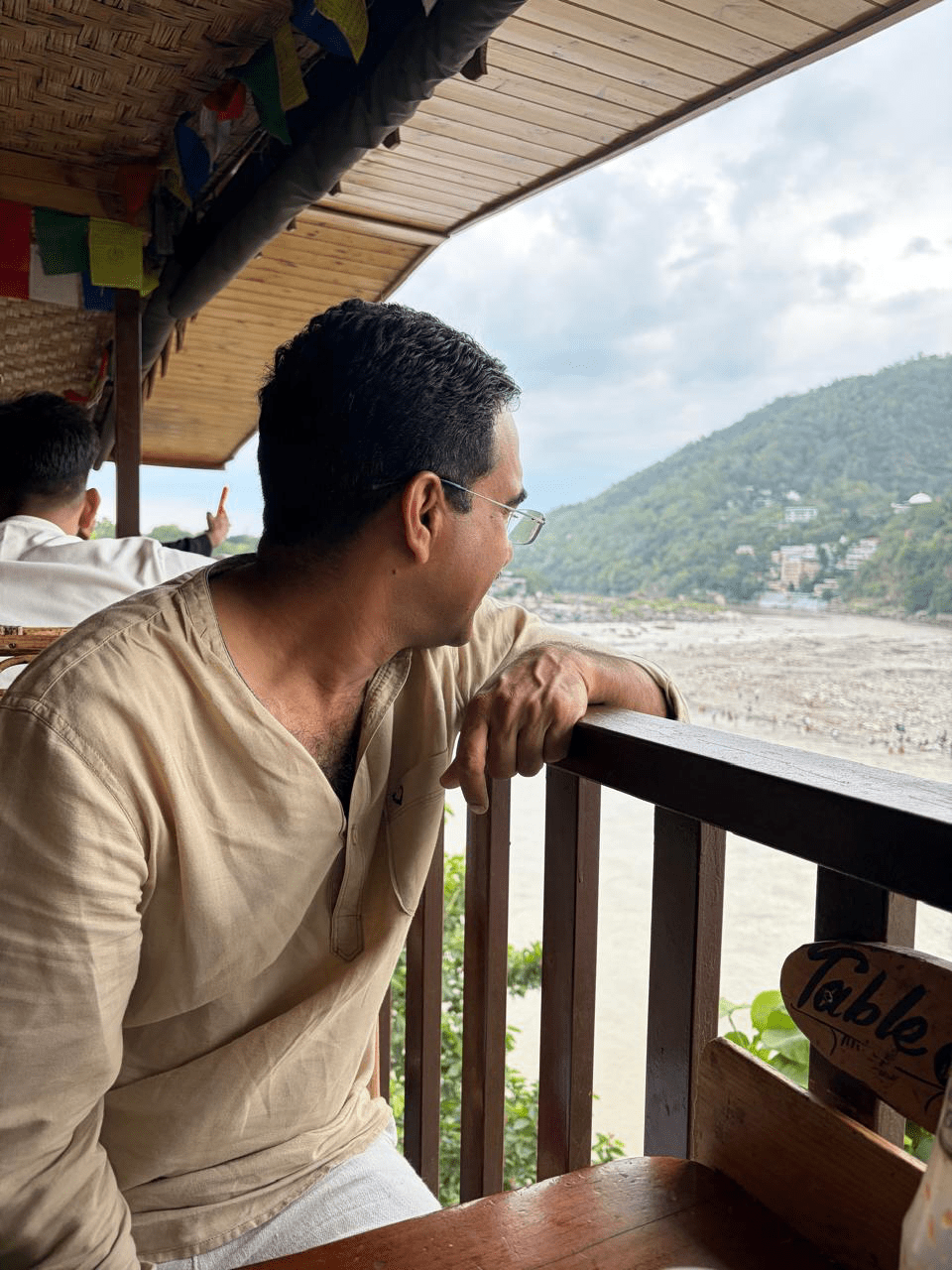
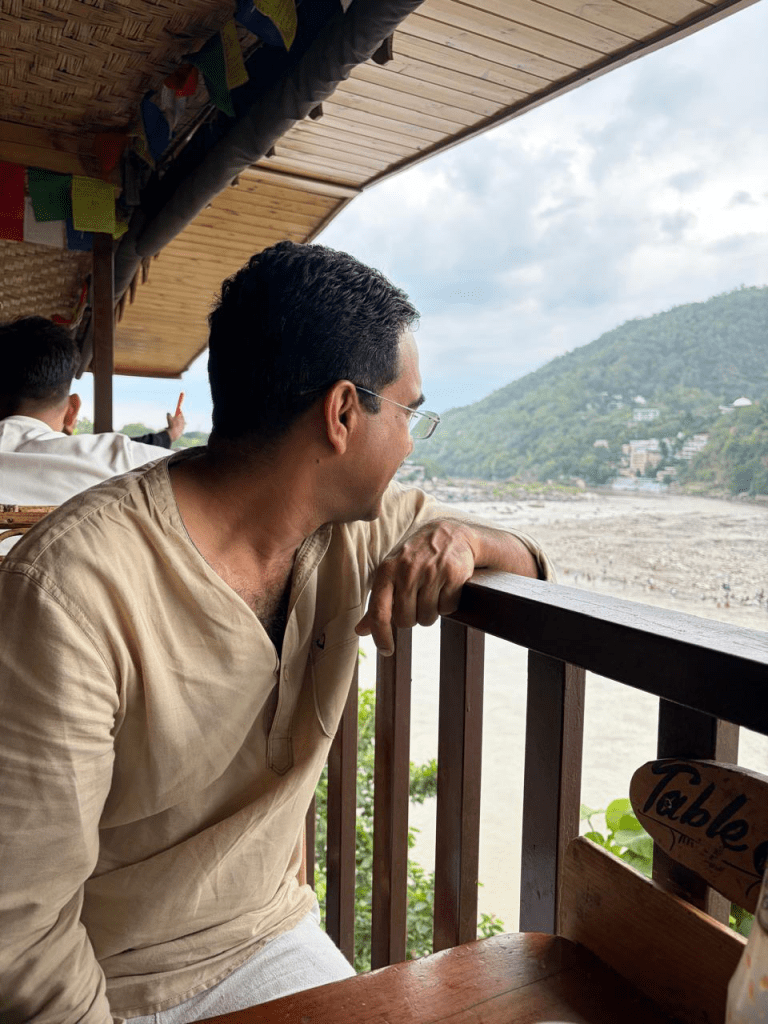
Crossing to the other side, we walked along a lane running parallel to the river and settled at a café built for Instagram — The Little Buddha. Perched at the third floor, it offered a commanding, picture-perfect view of the Ganga. A perfect place to sit sipping coffee, watching rafts drift by and tourists frolic noisily on the sandy banks below — all without the jarring sounds reaching us.
We did just that.
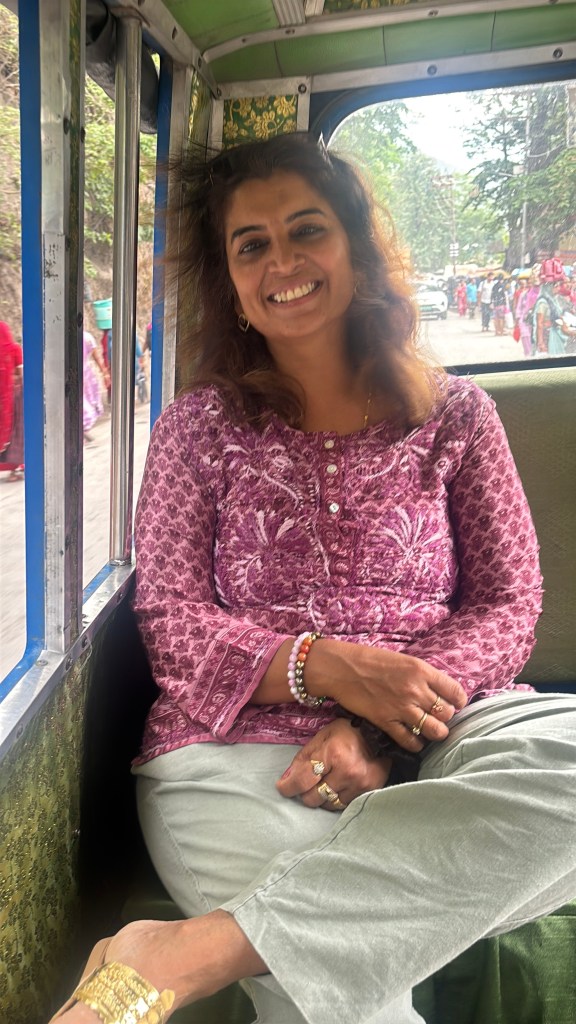
For the ride back to our room to collect our luggage and head to Delhi, we opted for a tuk-tuk — easily available, reasonably priced, and the preferred mode of travel here. We hired one for ourselves at Rs. 400. Our driver, Vinod, was honest and jovial. He took us through the back lanes, where we discovered another side of the town — old residences tucked away from the busy highway, yet close to the holy ghats. The narrow lanes belonging to the era when walking and cycling were the only modes of travel.
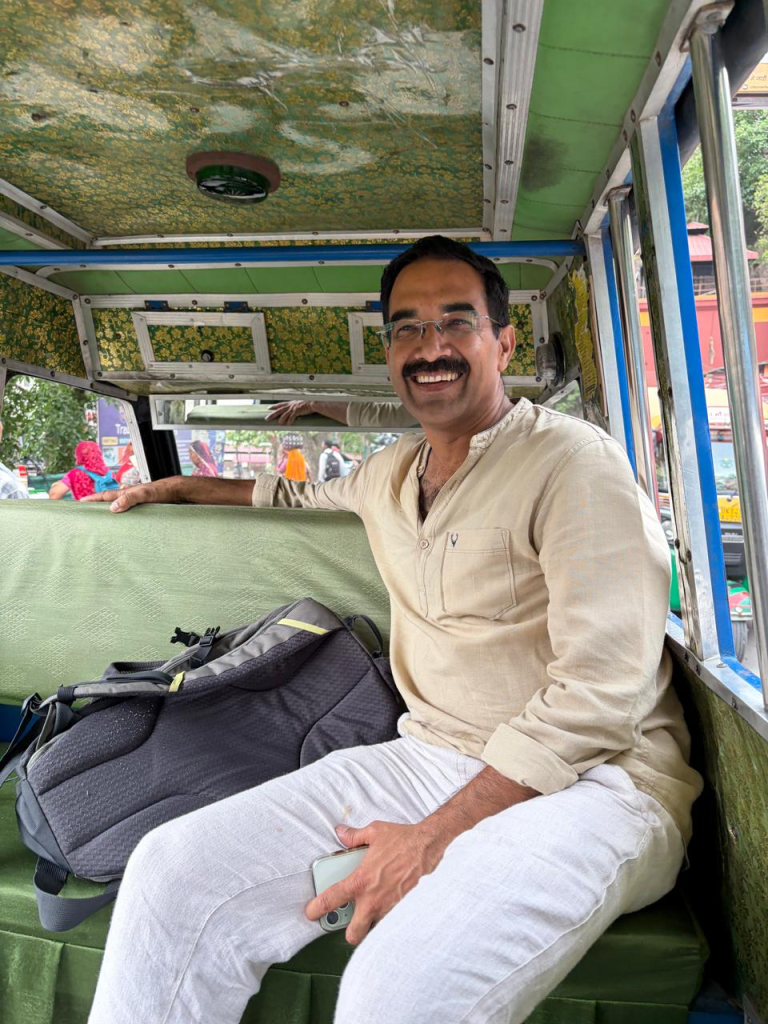
Vinod felt the town was experiencing pollution of a different kinds. The mindset of the people filling its streets had changed. They no longer came seeking spiritual wisdom or quietness — they sought the opposite: thrill, lights, and noise. That was a pollution no one could easily remedy. He made a living from it, as did so many others.
That’s the way life goes. No one to blame.
You find what you seek. If you want adventure, you will find it easily. If it is peace and spirituality you seek, you will have to search — and maybe you will find it.
We were contemplative as we drove back along the Dehradun-Delhi highway. We had changed, in some subtle way.
The Beatles played softly on Spotify.