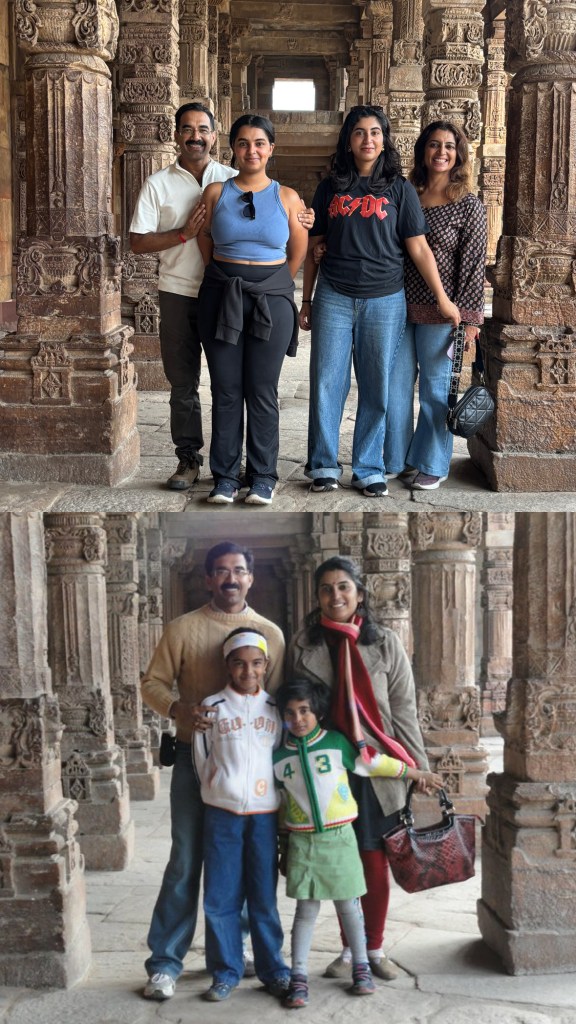
It was a trip to recreate a photograph, which was taken a decade and a half ago. A picture taken when the four of us were first visiting the tallest stone structure (238 ft tall). I am told it is about couple of feet shorter than Taj Mahal, but I wonder if it makes it less tall.
The Qutub Minar - the tallest one.
We took a bike ride to make it more memorable. To be more precise an e-scooter and a bike to cater for a family of four.
The morning ride, even though we started at around 6 am, wasn’t very free. The traffic seemed more hectic, when you were expecting an empty road.
We reached at half past six. A bit too early for the keepers of the Minar. The parking space was not open, because the man in charge was blissfully asleep. After banging on the prefab structure consistently for a minute, there entered a spark of life in an apparent ‘corpse-like’ sleeping guard. He was unapologetic, and for that matter, rather annoyed for such disturbance.
Doing the right thing was always tougher. We woke up the guard, obtained a parking ticket and parked our bikes at the designated space, ignoring his grumbles.
We paid ₹20 for each two-wheeler. ₹10 per wheel, I guess was the rate.
Among the many ticket counters that were constructed, there was only one that was open. And when the nation was celebrating a decade of digital transformation, the counter was only accepting cash. And unfortunately we weren’t carrying a shred of cash, relying on our phones to complete transactions through UPI. A good idea, that turned out to be a bad one.
The ticket seller sleepily pointed his lazy finger towards an information board imprinted with a QR code through which we could procure tickets online. ₹40 per head. Each fuming head, swollen with frustration, could have been charged a lot more. We promptly scanned and paid the currency in digital form. The payment happened but virtual tickets failed to land on our mobile. Despite multiple refreshes, when the tickets did not reach the inbox or the spam folder of our email, we approached the ticket seller, and requested an amicable end to this crisis by issuing us the prized entry tokens.
He agreed, after a few mandatory grumbles and deliberate confirmation of a valid transaction. We thanked him happily, I guess true happiness comes from a relief after an ordeal. He was responsible for both.
We entered the heritage place, protected by the Archaeological Society by scanning the coin at the entry portal. And as we entered, it felt as if we left the crumbling system behind to enter the well-kept ruins.
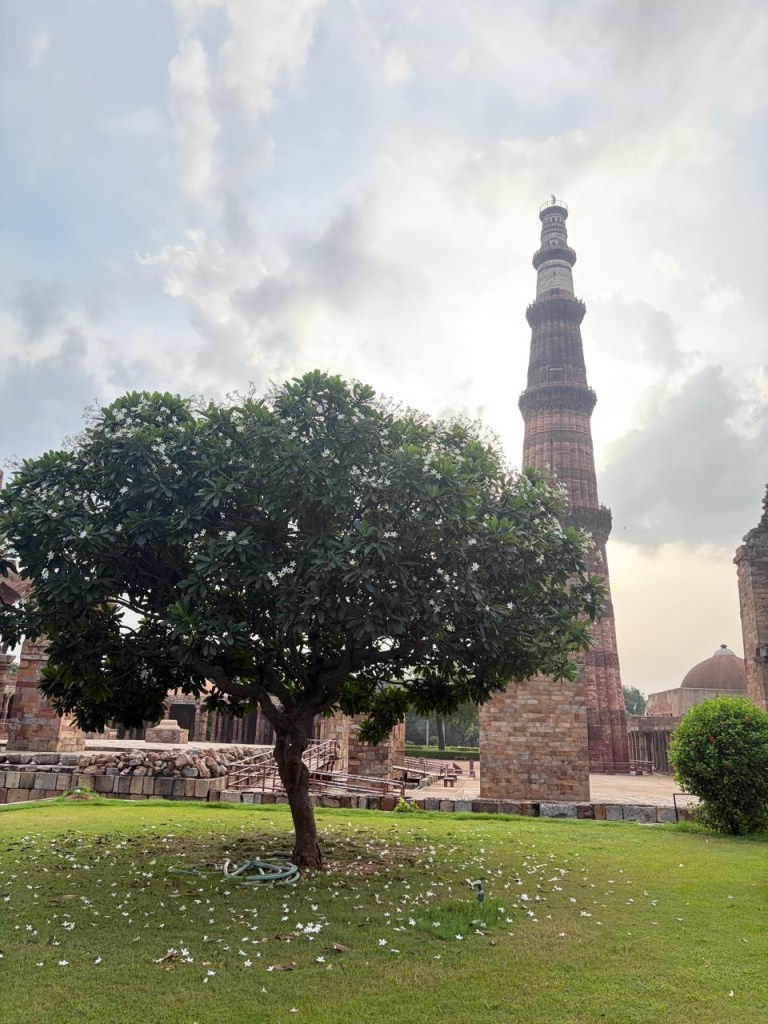
We seemed to have transcended time and stepped into a quieter past. More precisely around 1199 AD. The first view of the imposing sandstone structure was most amazing. It seemed to move into the view as we walked on the curved approach road. Silhouetted against the blue skies and the white cloud, it was a breathtaking sight.
Yes, it was the tallest one. It was touching the clouds.
We stopped and admired the creation of man in wonderment. And as anyone in times we live in would do, we created multiple digital imprints through our mobile phones. Ample packets of bytes were added to the virtual cloud (I wonder if what colour it must be) and in our memories.
Screenshot
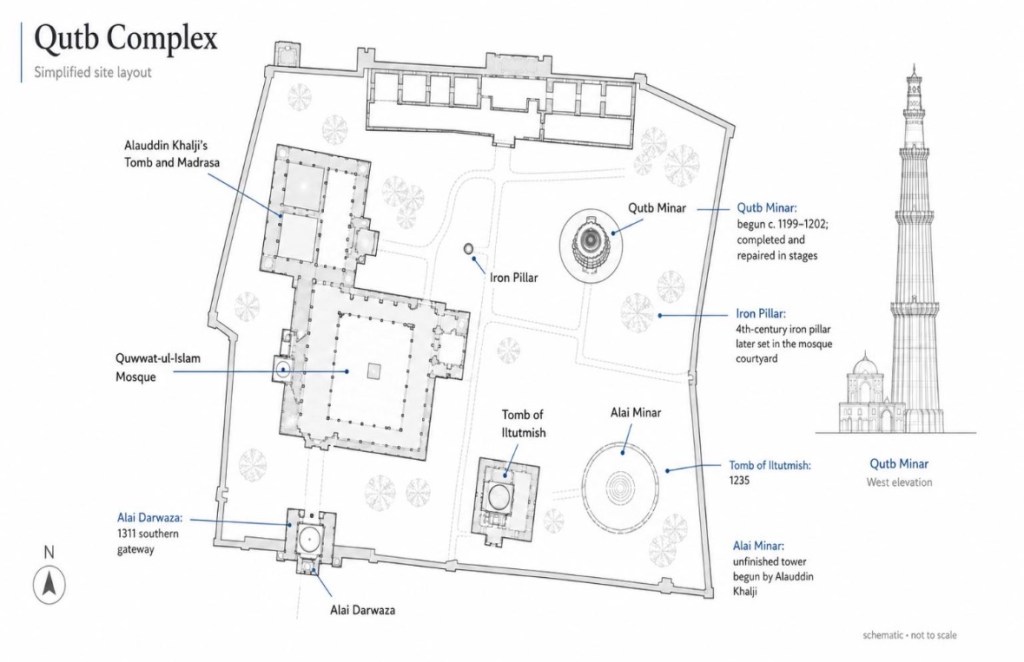
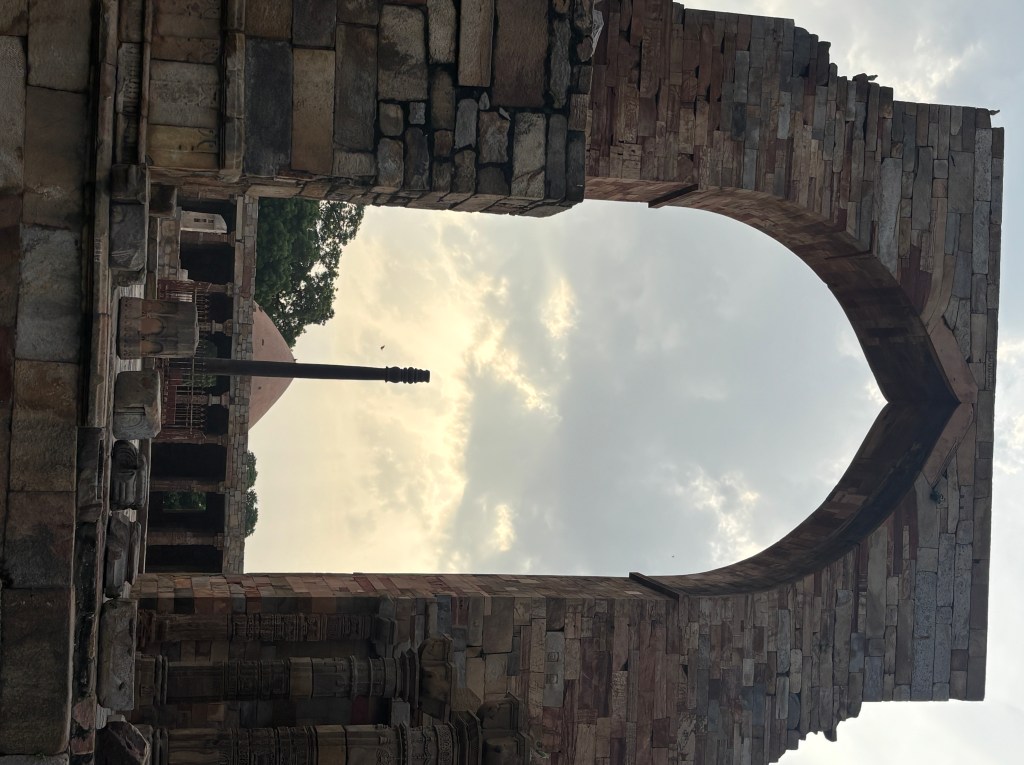
The Minar wasn’t in the center of the site. The site plan had the Iron Pillar in the center with Qutub Minar towards the east (left side as we enter). Beyond the iron pillar lay the Tombs of Iltutmish and Alauddin Khilji. Next to the Tomb of Iltutmish was the massive unfinished Alai Minar, while next to the tomb of Alauddin Khilji was the Alai Darwaza and a line of rooms which were the remains of Madrassa (a school for Islam). The rooms would have been airy and peaceful in the times when they were built and used. The recitation of Quran, discussions of the Hadith and conversations on Persian grammar seemed to silently reverberate in the ruins that remained for who wanted to hear.
There exists a faint line between religion and education. The distinction is critical.
We headed towards the tombs first, moving past the minar and the iron pillar (they were the obvious ones - and we were looking for the beyond)
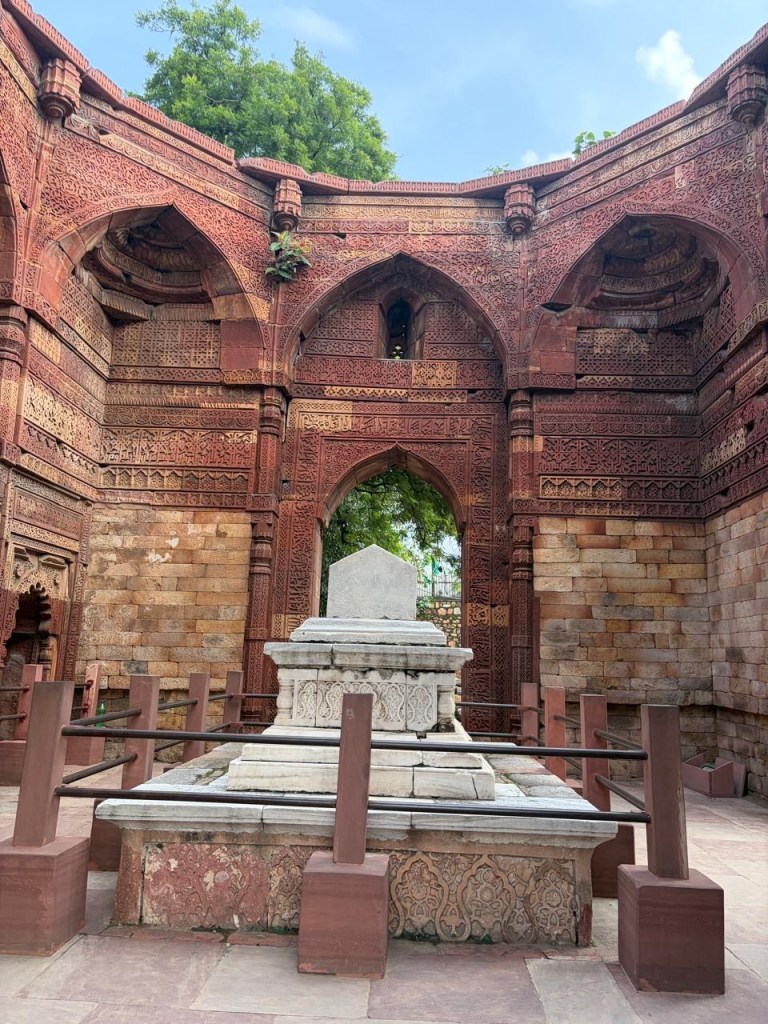
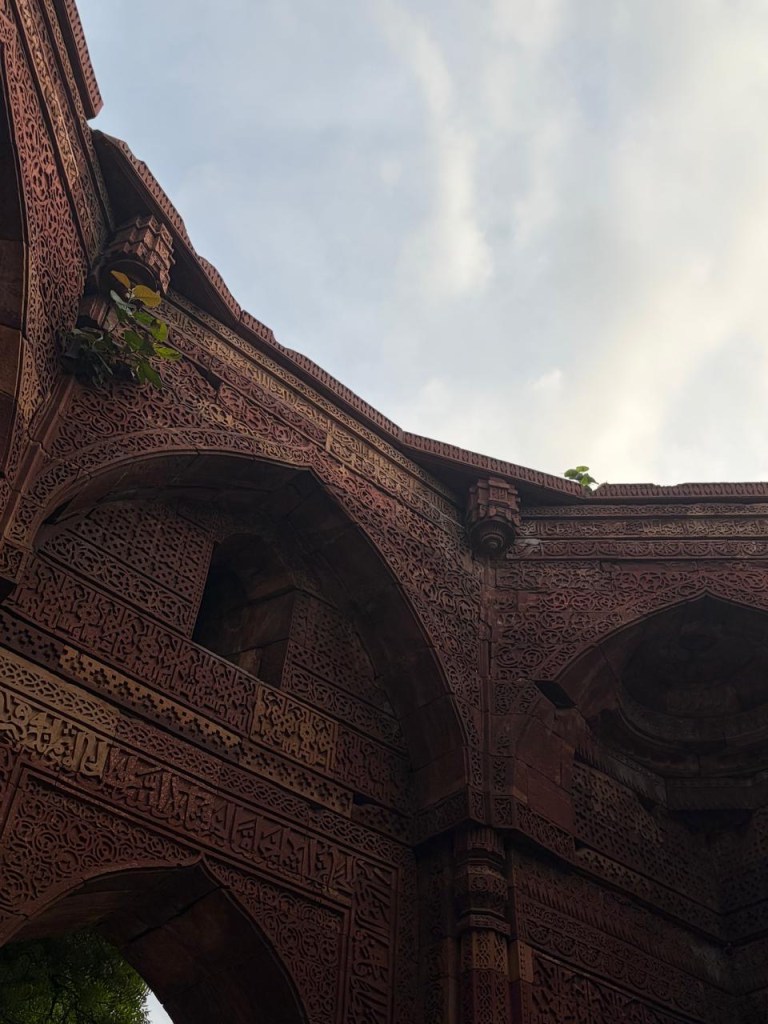
We first visited the Tomb of Iltumish. It was fairly well kept as compared to other structures. Iltutmish ruled the Delhi Sultanate from AD 1211 to 1236 and was the successor of Qutb-ud-din Aibak. The tomb was ordinary on the outside, with the path to the tomb being more spectacular than the exterior of the tomb itself. However, as we stepped into the precinct of the tomb the ornate architecture and richly carved interior walls were a surprising contrast. The tomb itself was majestic and beautifully carved. It was a fitting tribute to an illustrious ruler who rose to be a king from being a slave. He was a slave to his predecessor Qutb-ud-din Aibak, who recognised his abilities and eventually freed him and elevated him to important positions. He did not inherit the throne, but he earned it by defeating his rivals.
For a sultanate, nepotism would have been unfair. The best man ruled. And he ruled well.
Only part was the tomb that was not well kept was the dome.
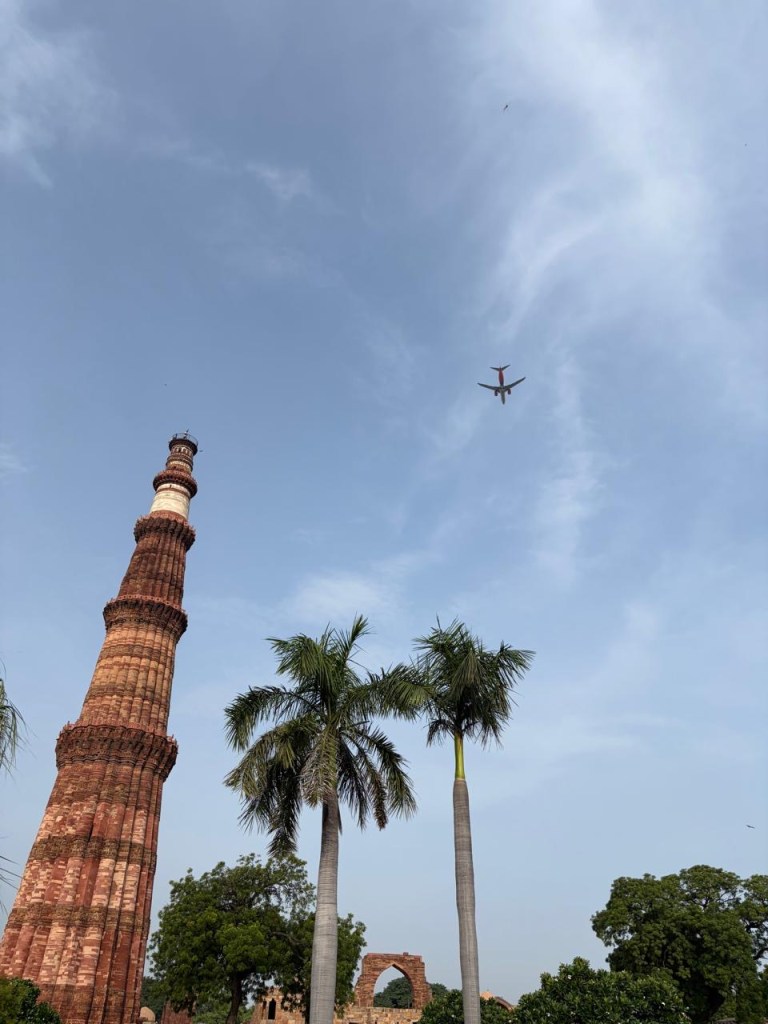
It was missing. We could see the flights passing overhead. A sight Iltumish couldn’t have fathomed. Or maybe he did.
He was succeeded by his Daughter, Razia Sultan - The only woman to rule the Delhi Sultanate. There was no trace of her at the site though. I wonder the omission had anything to do with the gender. Maybe and maybe not.
We then walked across to the tomb of Alauddin Khilji. The contrast was stark. For a person who conquered much of India, a ruthless and efficient ruler who was known to be an economic reformer, his tomb lay in ruins. It ironically lay surreptitiously near his failed attempt of building a Minar which would be twice the size of Qutub Minar. The ambitious ‘Alai Minar’ lay unfinished, duly highlighting the limitation of the mortal men. Alauddin Khilji died before the structure was complete, and it remained as such. No one followed the misplaced ambition. Maybe that’s why the Alai Minar failed and Qutub Minar survived.
He however built the grand ‘Alai Darwaza’ which is an attraction at the Qutub site.
His tomb had the prominent marking of the declaration of Love by Vivek and Sangeeta. Hope they were successful in love.
Alauddin Khilji wasn’t.
The Iron Pillar - the centrepiece of the Qutub Minar complex had outlived the rulers and the tombs that lay in ruins. The pillar remained rust-free despite being more than 1600 years old. It is believed to belong to the Gupta era. The Sanskrit inscription on the pillar spoke of king named Chandra, widely believed to be Chandragupta II Vikramaditya.
It survived the Delhi weather too.
Finally we were at the base of the Qutub Minar. It is known by the name of its conceiver - Qutb-ud-din Aibak, who died after he constructed the first storey. Iltumish, his successor added three more storeys.
Later after about 150 years, Firoz Shah Tughlaq repaired and reconstructed the upper portion of Qutub Minar, which was damaged by lightning. He even added the fifth and the final storey.
I wonder, why Firoz Shah Tughlaq didn’t find any prominent mention at the site, despite him actually making the Qutub - the tallest.
Maybe he was to be blamed to have not staked the claim.
Qutub Minar Complex is a fascinating mixture of faiths, eras and personalities. Qutb-ud-din Aibak, Alauddin Khilji, Firoz Shah Tughlaq, Chandragupta II, coexist peacefully. Maybe they wouldn’t have been so amicable if they were allowed be and weren’t separated by time.
Death has a calming effect, irrespective of how great you think you are.
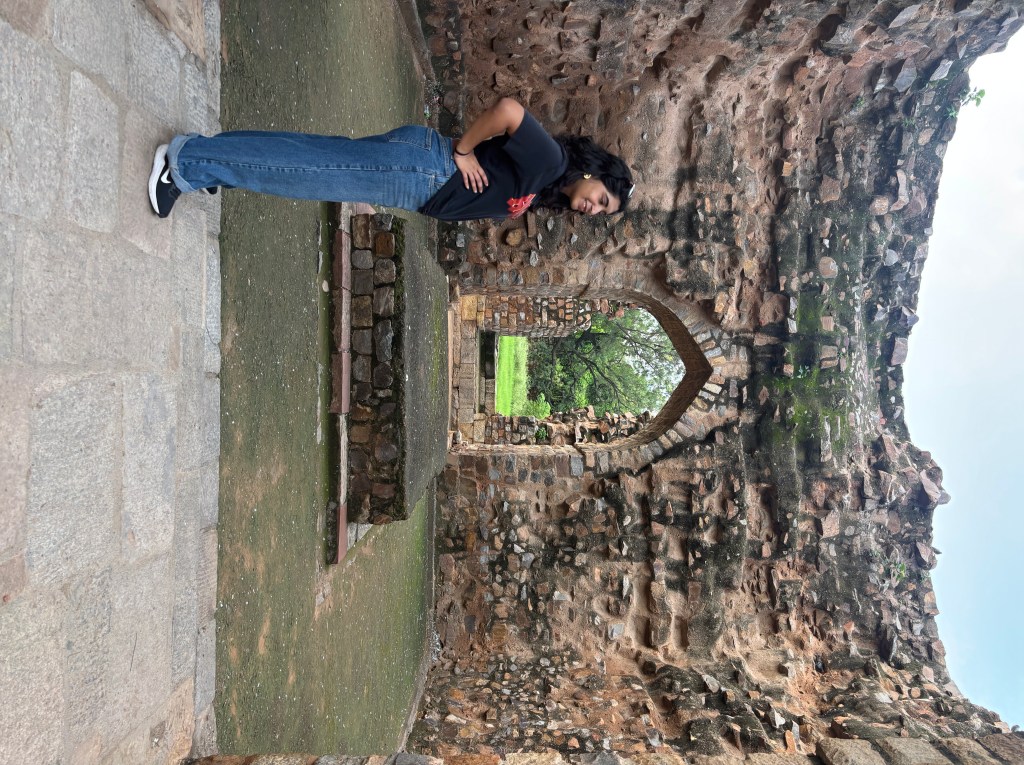
We had seen is all, at least what the eyes could see. Finally it was to click our picture of ‘then ’ and ‘now’. At the same very spot, separated by a decade and half.

The picture was taken.
We had changed…the place hadn’t.

The Qutub Minar stood tall, watching, the time flowing by.


Thanks for the tour of Qutab minar. I’ve heard a lot about it. And now I’ve seen it through your eyes
LikeLiked by 1 person
👍👍
LikeLiked by 1 person
🙏🏼🙏🏼🙏🏼
LikeLiked by 1 person